

Dear Friend
An open letter to a Facebook comment ... mostly because my response was too long to fit.

Three days ago, I saw this picture on Instagram. It filled me with hope and positive energy, so I shared it on my Facebook page.
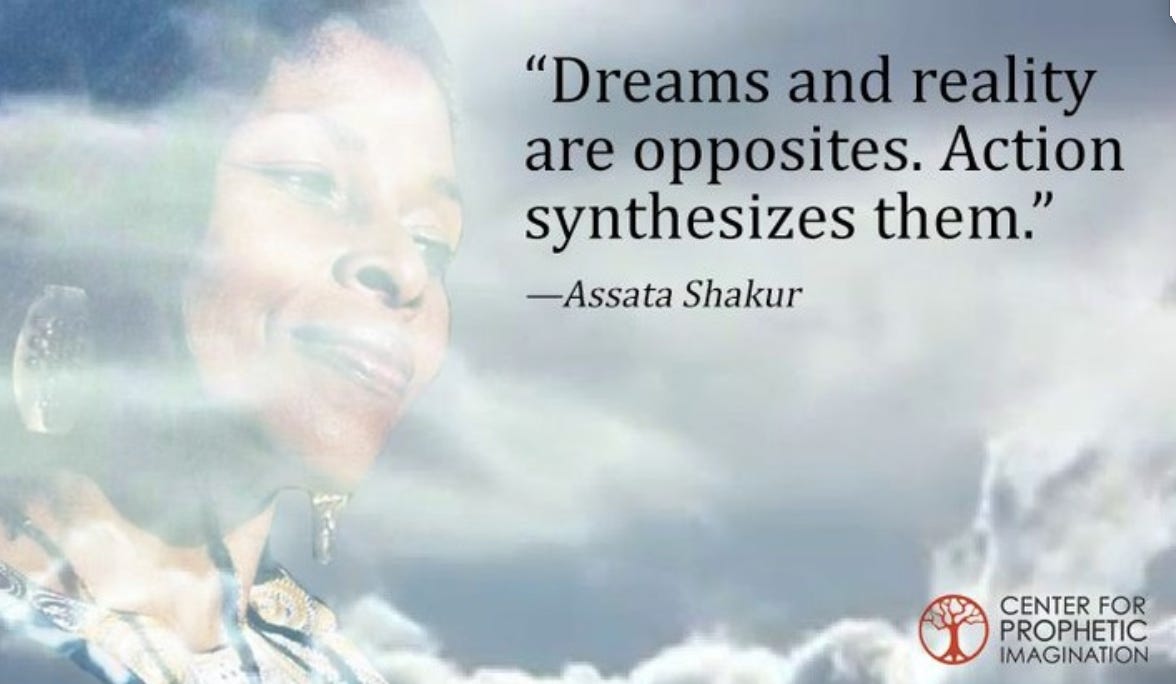
Yesterday, a former college roommate left this comment below it:
You do realize this is a racist and political terrorist you are glorifying? She murdered a man and is pure evil. Disgusting
I sat with that comment for 24 hours. I haven’t seen Tom (I’ll use his first name because he did not post anonymously) since I graduated University of Missouri in 1990… and I remember him as a gentle, decent, funny guy that I genuinely liked and appreciated.
35 years is a long time. Looking at his Facebook page, we have apparently gone down very different roads. And yet when I see that name I still see that human being …. I hope he sees the same in me.
As I sat with the comment I thought I could do several things.
First, I could delete it. I’m fine with a “my page, my rules” approach to social media … especially when someone’s comment is hateful or defamatory.
Second, I could try to reach out to him personally.
Third, I could respond to the comment in the way he had chosen to engage me … on my Facebook page.
I chose the third option. And as I wrote (and wrote and wrote and wrote), I tried to picture sitting across from my friend Tom and responding in love. I am sure I didn’t hit the mark the entire time.
As often happens with my writing (and preaching, as many of you know too well!) — the response got a little lengthy. And when I tried to post it as a comment I far exceeded the character limit.
So … I decided to post it as a substack and then leave the link in the comment in hopes he would read and continue the conversation … and also because perhaps, as Arlo Guthrie once said “or YOU might be in a similar situation” … and I thought I could show you one imperfect person’s imperfect way of responding for your consideration.
Here goes:
Dear friend, I hope you are well.
In a short comment, you managed to raise several important issues (well done!). It will take a bit, but I will try to address the ones I see.
First, Assata Shakur as a racist.
I would ask for your data on this. What makes Assata Shakur a racist.
Using the Merriam-Webster dictionary as (I hope) a non-controversial resource, their definition of racism is:
“A belief that race is a fundamental determinant of human traits and capacities and that racial differences produce an inherent superiority of a particular race.”
Other definitions would add that exercising “isms” such as racism, sexism, etc. require the ability of a group to hold power over another … but I won’t even go there for the purposes of this conversation.
Assata was a revolutionary black activist and her participation in the black power movement was not a statement that blacks are superior to whites but that our current society – imperialist and capitalist – fosters deep systemic inequalities and oppression for black people and that a societal revolution is necessary for equity to be achieved.
To the extent that she is identified with black nationalism, it is her deep skepticism that any such revolution is possible in our existing order.
Again, I’d ask for you either to provide data that Assata is a racist based on this definition or argue that the Merriam-Webster definition is insufficient
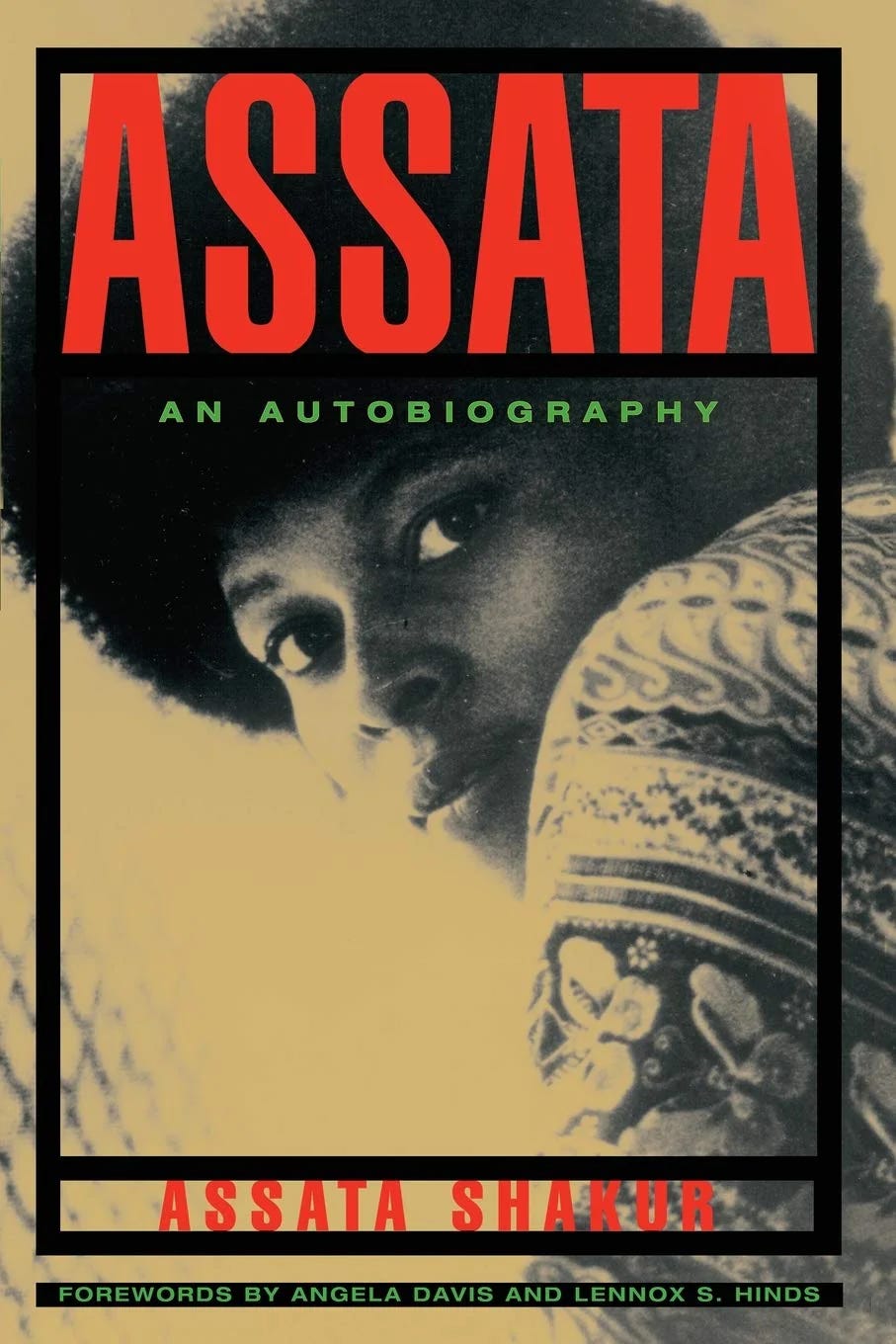
To learn more about Assata’s views, I encourage you to read her autobiography. You can order it here .
Second, Assata Shakur as a terrorist.
Again, let’s go to the Merriam-Webster definition:
“the unlawful use or threat of violence, especially against the state or the public, as a politically motivated means of attack or coercion"
This isn’t as cut and dried. And … the key word here is “unlawful.” By this definition, state violence against people is not terrorism but people’s violence against the state is.
By this definition, Assata can be considered a terrorist because she has threatened violence against the state. It is important to note that, by this definition, oo were the so-called “founding fathers” of the United States of America, whom we glorify regularly.
This is summed up beautifully in the musical 1776 where Benjamin Franklin has this conversation with John Dickinson about the nascent Declaration of Independence.
John Dickinson: Mr. Jefferson, are you seriously suggesting that we publish a paper declaring to all the world that an illegal rebellion is, in reality, a legal one?
Dr. Benjamin Franklin: Oh, Mr. Dickinson, I'm surprised at you. You should know that rebellion is always legal in the first person, such as "our rebellion." It is only in the third person - "their rebellion" - that it is illegal.
A quote from literature and not the source … but sums up nicely the philosophy of the Declaration.
And … it’s important not to stop there. Assata’s views on violence were nuanced, as were her beliefs on most things. I do not share all of them, so I ask that you remember these are her words and viewpoints, not my own.
First, she recognized that the primary violence in the current situation of being black in America is the violence the state routinely visits on black people not only through physical violence of police brutality, selective arrest and prosecution and the like, but the violence of poverty of resources, education and opportunity.
Her allowing for and at times threatening/advocating for violence against the state was in response to state violence creating necessary conditions for violence. She advocated for careful consideration of context in use of violence – not an indiscriminate use of violence – primarily as a method of self-defense for people defenseless against state violence.
Third, that by posting a quote from someone I am “glorifying” them.
I’m not agreeing or disagreeing with this statement and… I want to point out it is not as cut and dried as your statement might seem (and perhaps that was not your intention).
There is an important and longer conversation to be had about whether quoting someone is glorifying them – and also whether you have to agree with everything … or even the central tenets of what … someone believes to quote them.
Yes … when I post a quote from someone, I am amplifying their voice. And there is absolutely that is a way that I am “glorifying” them. And … it’s more complex than that – especially when you start cherry-picking their history.
The truth is, even people who behave pretty awfully can say some pretty wise things. Take this quote:
“Women hold up half the sky”
This is a beautiful phrase that has been used for decades to sing of the natural power of women and importance of gender equity. I hope and (dare I say, assume) we both believe in those things.
Do you know who said it? Chairman Mao … whose policies directly contributed to the deaths of tens of millions of people.
Does that mean we take everything Mao ever said and throw it away?
Does that mean we don’t use that quote ever?
You are a vocal supporter of Donald Trump. And yet, unless I misjudge you, I imagine there are things that Donald Trump has done, particularly in his treatment of women and the institution of marriage, that you find abhorrent. And yet your overall admiration for Donald Trump at least appears to be greater than what you find abhorrent as you have no problem celebrating him on your Facebook page.
So, the real question is … where is the tipping point? Like most things, different people in different contexts can faithfully come to different points of decision on that.
Fourth, Assata Shakur murdered a man.
Here again, we have a situation that is far more complicated than the statement you made. Assata Shakur was convicted of the 1973 murder of a state trooper in a shootout on the New Jersey Turnpike. That is an undisputed fact.
Little else about that case is undisputed.
Here I will let Assata speak for herself. This is from an open letter she wrote in March, 2024
“By 1969, the Black Panther Party had become the number one organization targeted by the FBI’s COINTELPRO program. Because the Black Panther Party demanded the total liberation of Black people, J. Edgar Hoover called it “the greatest threat to the internal security of the country” and vowed to destroy it and its leaders and activists.
“In 1978, my case was one of many cases brought before the United Nations Organization in a petition filed by the National Conference of Black Lawyers, the National Alliance Against Racist and Political Repression and the United Church of Christ Commission for Racial Justice, exposing the existence of political prisoners in the United States, their political persecution and the cruel and inhuman treatment they receive in U.S. prisons. According to the report:
“The FBI and the New York Police Department, in particular, charged and accused Assata Shakur of participating in attacks on law enforcement personnel and widely circulated such charges and accusations among police agencies and units. The FBI and the NYPD further charged her as being a leader of the Black Liberation Army, which the government and its respective agencies described as an organization engaged in the shooting of police officers.
“This description of the Black Liberation Army and the accusation of Assata Shakur’s relationship to it was widely circulated by government agents among police agencies and units. As a result of these activities by the government, Ms. Shakur became a hunted person; posters in police precincts and banks described her as being involved in serious criminal activities; she was highlighted on the FBI’s most wanted list; and to police at all levels, she became a ‘shoot-to-kill’ target.”
“I was falsely accused in six different “criminal cases,” and in all six of these cases, I was eventually acquitted or the charges were dismissed. The fact that I was acquitted or that the charges were dismissed did not mean that I received justice in the courts; that was certainly not the case. It only meant that the “evidence” presented against me was so flimsy and false that my innocence became evident. This political persecution was part and parcel of the government’s policy of eliminating political opponents by charging them with crimes and arresting them with no regard to the factual basis of such charges.
“On May 2, 1973, I along with Zayd Malik Shakur and Sundiata Acoli were stopped on the New Jersey Turnpike, supposedly for a “faulty tail-light.” Sundiata Acoli got out of the car to determine why we were stopped. Zayd and I remained in the car. State trooper [James] Harper then came to the car, opened the door and began to question us.
“Because we were Black and riding in a car with Vermont license plates, he claimed he became “suspicious.” He then drew his gun, pointed it at us and told us to put our hands up in the air, in front of us, where he could see them. I complied, and in a split second, there was a sound that came from outside the car; there was a sudden movement, and I was shot once with my arms held up in the air and then once again from the back.
“Zayd Malik Shakur was later killed; trooper Werner Foerster was killed; and even though trooper Harper admitted that he shot and killed Zayd Malik Shakur, under the New Jersey felony murder law, I was charged with killing both Zayd Malik Shakur, who was my closest friend and comrade, and charged in the death of trooper Foerster. Never in my life have I felt such grief. Zayd had vowed to protect me and to help me to get to a safe place, and it was clear that he had lost his life trying to protect both me and Sundiata.
“Although he was also unarmed, and the gun that killed trooper Foerster was found under Zayd’s leg, Sundiata Acoli, who was captured later, was also charged with both deaths. Neither Sundiata Acoli nor I ever received a fair trial. We were both convicted in the news media way before our trials. No news media were ever permitted to interview us, although the New Jersey police and the FBI fed stories to the press on a daily basis.
“In 1977, I was convicted by an all-white jury and sentenced to life plus 33 years in prison. In 1979, fearing that I would be murdered in prison, and knowing that I would never receive any justice, I was liberated from prison, aided by committed comrades who understood the depths of the injustices in my case and who were also extremely fearful for my life.
“The U.S. Senate’s 1976 Church Commission report on intelligence operations inside the USA revealed that, “The FBI has attempted covertly to influence the public’s perception of persons and organizations by disseminating derogatory information to the press, either anonymously or through ‘friendly’ news contacts.” This same policy is evidently still very much in effect today.”
+++
Because, as the saying goes, “one man's terrorist is another man's freedom fighter" … you and I will have differing views of Assata’s actions. You have stated your opinion. I wanted to use the space on my page to let her have her say.
Fifth, Assata Shakur is “pure evil”
When you use phrases like “pure evil” you are bringing theological language into play which is kind of my ballpark … so I want to respond on theological grounds.
I do not deny that evil exists – though the phrase “pure evil” feels like kind of a buzzphrase along the lines of “pure energy” in science fiction – I do deny that any human being can be “purely (nothing but) evil.”
My rationale is simple. A central tenet of the faith I believe we both share is that human beings are created in God’s image and good (Genesis). All you have to do is look around and see that we don’t act that way all the time.
And yes … evil infects our hearts. We are drawn away from the love of God and the love God longs for us to have for ourselves and one another.
And … no matter how far we stray, our core nature of being made in God’s image and good does not change.
As my mentor Hays Rockwell often said, “the image of God is on every person, every one … only on some it is in deep, deep disguise.”
As someone who often resembles that remark, I don’t believe anyone is purely evil.
This is not just a “how many angels can dance on the head of a pin” theological point … but an absolutely critical one for how we live our lives.
When we declare another person as “pure evil” … we are basically saying they are no longer human (if all humans are in God’s image and good) and thus they do not need to be treated with any humanity, dignity or to have any rights at all – including the very right to life.
Language like this is at the heart of all discrimination, oppression and genocide. It is at the heart of all dehumanization of every kind, which, in my opinion and experience, is the primary source of misery and death in the world.
After Jesus, there is no one I aspire more to be like than Mahatma Gandhi. There is no one I less aspire to be like than Adolf Hitler. And yet, when Gandhi wrote Hitler a letter urging him to stop his genocidal and imperialistic actions, he opened it with “Dear Friend.” I preached a sermon on this if you’re interested:
If Gandhi could see the humanity and good in Hitler – in as deep disguise as it might have been – then I believe we all can aspire to see it in one another.
And though so we deeply disagree on much, I will close this as I began it. With best wishes for you.
Your friend,
Mike
Well done, Mike! Always a defender of those on the margins! What a great response to someone who clearly sees through a very different lens- kind, respectful, thoughtful, and well-researched. Thank you.
This was a fascinating and insightful post. Thank you for researching it, writing it and sharing it. I agree with you.