
The difference is a question
A sermon preached at St. Aidan's Episcopal Church in San Francisco, CA on Sunday, July 20, 2025

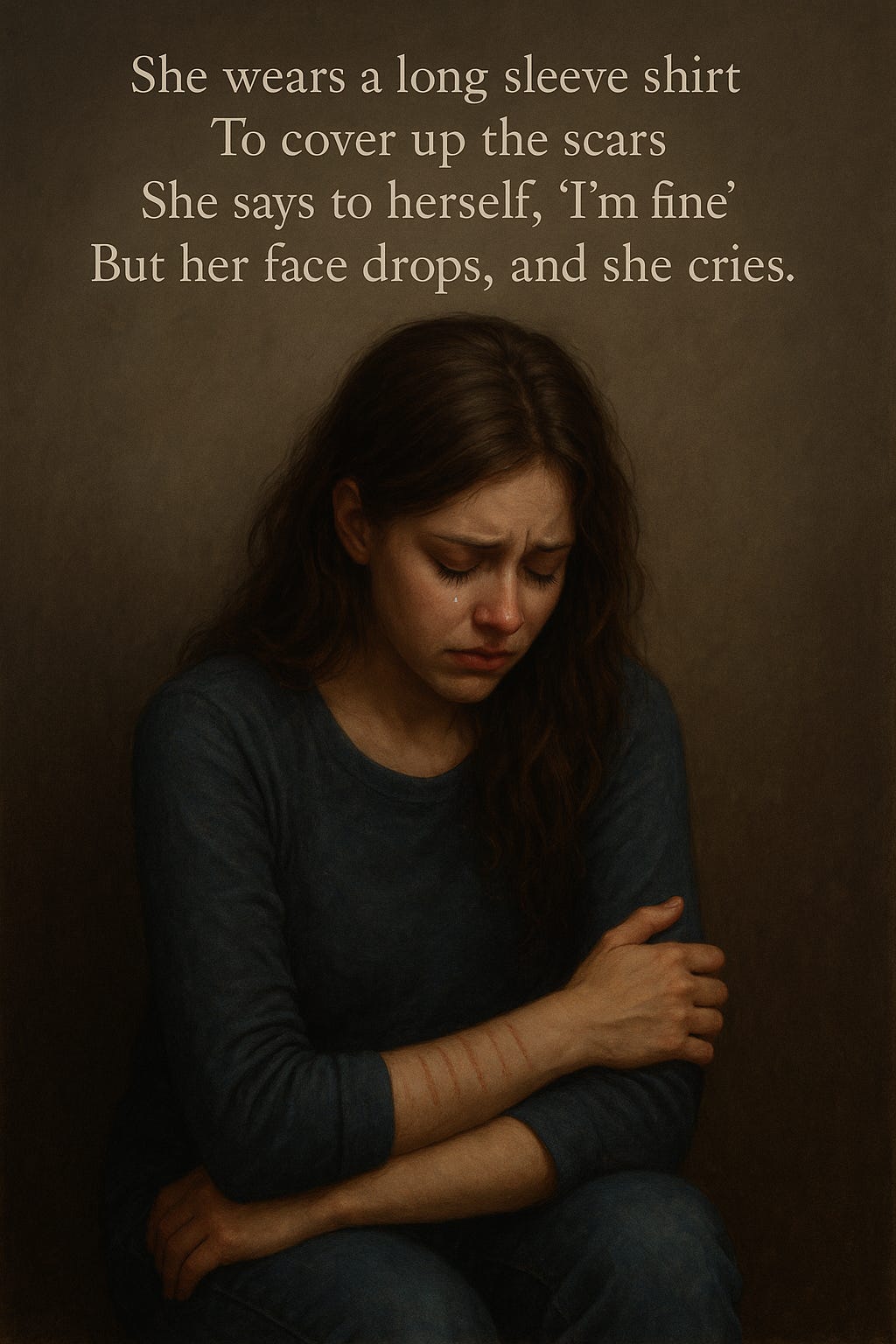
So many times, the difference is a question
A question instead of a statement.
…instead of a judgment
A question instead of silence.
So many times a question is the difference
Between judgment and compassion.
Enmity and community.
Death … and life.
A simple question
What is your story?
Tell me why?
“She wears a long sleeve shirt
To cover up the scars
She says to herself, ‘I’m fine’
But her face drops, and she cries.”
I hope someday archaeologists discover a long-lost text called The Gospel According to Martha
A Gospel written by the women and not just the men.
And in that Gospel, I imagine the story we just heard is told as a parable.
Perhaps it would be called,
“The Parable of the Ungrateful Houseguest”
It would be a story of a woman who invited a revered teacher into her home and tried to do everything she could to make him feel welcome and comfortable.
And how her sister, who never did anything to help, just sat there as she took on all the tasks of love by herself.
And how when she reached out to the teacher to encourage her sister to join in the work of hospitality … work the teacher himself had said was one of our deepest joys .. instead he criticized her loving efforts and praised her sister’s laziness.
And the parable would close with these words:
“And the man never asked the question.
He never asked, ‘Why do you work so hard?’
He never said, ‘Tell me your story?’”
And the woman swallowed her pain … as her mother and grandmother had before her … and as generations of daughters have ever since.
Or perhaps someday archaeologists discover The Gospel According to Mary.
And in that Gospel, perhaps it would be called,
“The parable of the Embarrassed Woman”
There was a woman who lived with her older sister – and her older sister invited a teacher, a healer into their home. And this woman sat at his feet and he talked and talked … you know … as men often do.
And she thought, “Maybe if I wait long enough he will stop talking at me and start wondering about me.”
But she was terrified because she had never been told that she was worth anything.
Attention mortified her.
She longed not to be recognized but just to be seen
… to be heard
… to be loved.
And then when her sister criticized her, the teacher castigated her sister and celebrated her. She knew he meant well, but how her sister would make her pay for that later. Oh, how she wished she could just melt into the wall when that happened.
And the parable would close with these words:
“And the man never asked the question.
He never asked, “Why are you so quiet?”
He never said ‘Tell me your story?”
“She wears a long sleeve shirt
To cover up the scars
She says to herself, ‘I’m fine’
But her face drops, and she cries.”
These words by an indie band long lost to my memory remind me of a friend from my high school and church group in Tucson, Arizona.
I would see her on the city bus every morning as we rode to school and at the rectory on Sunday evenings.
And one year even as the weather got desert hot, she would still wear long sleeves.
I wondered … but I never asked.
There were whispers … but I never reached out.
I was too scared.
I thought, “maybe it’s not my place.”
So many times, the difference is a question
A question instead of a statement.
instead of a judgment
A question instead of silence.
So many times, a question is the difference
Between judgment and compassion.
Enmity and community.
Death … and life.
It was a question I didn’t ask.
She wore a long sleeve shirt
To cover up the scars
She said to herself, she said to us all: ‘I’m fine’
But I wonder when she was alone, if her face dropped, and she cried.
You’ve probably guessed already that this morning’s Gospel reading kind of bugs me.
It makes me mad at Jesus … and then I remember.
I remember that Jesus was human. And frankly, on the fully divine-fully human Jesus spectrum, I need the human part a lot more than I need the divine.
I need the Jesus who screws up.
I need the Jesus who is too oblivious or too fearful to ask the question that could mean everything.
That Jesus reminds me that when I do that, there is hope for me.
That we can be wrong and screw up and still e loved.
That Jesus reminds me it’s never too late to ask the question.
This Gospel is Jesus at his most human … I know how I get when going on and on and on and thinking what I have to say is so important … and am interrupted by someone.
I know I can get that guy thing and think … you know, if you would just be good and sit down and listen to me everything would be OK.
And – respect – I’m not sure even I would go full Kardashian like Jesus does by adding:
“Why can’t you be more like your sister?”
Jesus jumps to judgment – it is an incredibly human thing to do.
And the reading closes with Jesus saying:
“Martha, Martha, you are worried and distracted by many things; there is need of only one thing. Mary has chosen the better part, which will not be taken away from her."
That’s the end of the story. Both Martha and Mary are silenced.
The question was never asked.
And we will never know.
But I wonder.
How might the story have been different if Jesus had asked, Martha:
“What is your story?
“Martha, why so busy?”
Maybe Martha wouldn’t know the answer … but maybe the question would have led her on a path of healing and self-discovery that would have changed her life.
The brilliant biblical scholar Dr. Wil Gafney taught me this phrase to use with text like this:
“in my sanctified imagination”
So, in my sanctified imagination I fill in some of what the text doesn’t give us.
I wonder if the story inside Martha was one of a woman in her late 20s unmarried and heading up a household of her younger sister and brother – I mean, that’s what the text supports.
In my sanctified imagination and knowing the women I know who either by parents’ absence or dysfunction have been forced from a young age to hold the family and household together, I wonder if Martha might have realized that she didn’t know any other way. That this is how she loved but that also on some level she was afraid that the labor is the only value she has.
In my sanctified imagination, I wonder if Jesus had said to Martha:
“What is your story?”
“Martha, why so busy?”
If Martha would have broken down and cried:
“Jesus … do you think I want to be like this? I want to be like Mary. I want to rest. Oh my God, how desperately I want to rest. But I can’t. You just don’t understand … I can’t.”
And then maybe instead of being met with a pointing finger, she would have been met with open arms to enfold her pain and her tears.
And I wonder.
How might the story have been different if Jesus had asked, Mary:
“What is your story?
“Mary, why so quiet.”
And then in my sanctified imagination, I wonder if that question wouldn’t have unlocked Mary’s heart. And maybe just to herself or maybe in the softest of whispers she might have said:
“Jesus … who wants to listen to me?
“I am a woman of 22 in a world where women are married by 16.
“My sister runs the house. My brother is a man.
“I am nothing.
“I am invisible.
“The only thing I have to look forward to is living like this until I die alone.
“And I am so alone, Jesus, I am so alone.
“And in my heart, I am afraid I always will be.
“In my heart I am afraid I am nothing.”
And then instead of being met with a spotlight that just meant more trouble for her when Jesus left and a misunderstanding that left her feeling even more unseen and unheard, Jesus might have been able to say,
“Mary … you are never alone … I am always with you.”
“Mary … you are not nothing … you are everything.”
“Mary, I see you.”
I read this story, and I’m back on that bus riding to school.
The question would have been so easy for me.
I wouldn’t have even had to mention the sleeves.
I could have just asked:
“Rachel, how are you doing?”
Or maybe even just said,
“Rachel, I notice you’re quiet. If you ever want to talk, I’m here.”
Or maybe being a little bolder and nodding at the sleeves and saying,
“I know things have been rough for you recently (because, frankly, I knew … we all knew). Rachel, I know things have been rough for you recently and I’m concerned about you. You matter to me.”
I don’t know if she would have talked. Or even would have heard me. But maybe on some level she would have known that she was seen,
that she mattered,
that at least one person was more interested in listening to her than talking about her.
In my experience, this Gospel story has always been interpreted as a binary – reflection good … action bad. After all, the author of Luke has Jesus saying,
“Mary has chosen the better part.”
I can’t count the number of sermons I have heard like that. I imagine I’ve preached some of them myself.
The truth I am learning is, there is nothing wrong with action and there is nothing wrong with reflection. Both can be wonderful, and both can be unhelpful.
Action can be healing and transformative, and it can also tempt us to spend all our energy spinning our wheels in inconsequential effort.
Reflection can be grounding and create space for wisdom … and it can also be a tactic of delay and work and conflict avoidance that just is an excuse to keep us in our comfort zones.
What’s wrong is the binary.
What’s almost always wrong is the binary.
One of my many favorite quotes from The West Wing is when President Bartlet says,
“Every once in a while... every once in a while, there's a day with an absolute right and an absolute wrong, but those days almost always include body counts.”
And it makes me wish when Martha had questioned Jesus instead had sung Rumi to her:
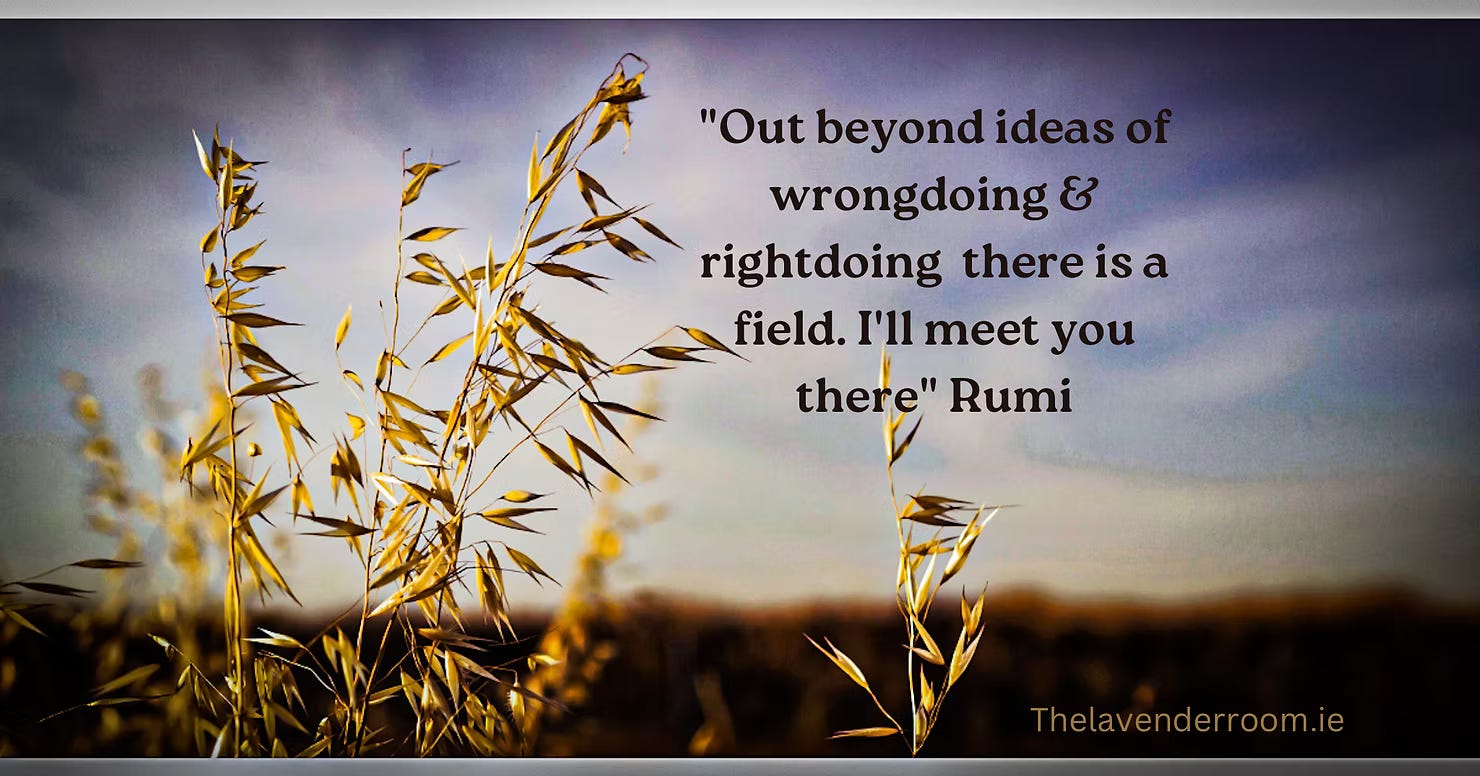
“Out beyond ideas of wrongdoing and rightdoing,
there is a field.
I’ll meet you there.”
And then asked the question.
As happens so often, the statement … particularly the judgment … shuts us down.
But questions … questions can break us open.
And one of the most powerful questions that breaks us open … that lets love in is …
Tell me why?
What’s your story?
If you’ve been online at all this week, you’ve been inundated with the kisscam couple at the Coldplay concert.
The two people whom the camera captured in a loving joyful embrace … except they are both married to other people … and their instant reaction was the reaction of shame.
And in a divided nation, that video has been disturbingly uniting. Because it seems everyone of every stripe has gleefully jumped to judgment. I even laughed out loud at one take on it:
“What a horrific way to find out your spouse likes ColdPlay”
I tagged that with a laughing emoji even though it was just a more satirical jump to judgment
… and I even like ColdPlay.
But the longer I have sat with it, the more it has bothered me.
And the more I have wondered.
Why such vehemence and glee in our judgment?
Why?
Is it because we are feeling unstable and weak in our lives right now and judgment and self-righteousness makes us feel strong?
Maybe … I’ve certainly been tempted to that.
In some cases, is it because there are people posting on this who are doing the same thing and it’s a case of methinks they dost protest too much?
Sure … but judgment doesn’t help them either.
It’s human. I mean … you can even say Jesus in this story was kind of posting a shaming viral video of Martha scurrying around.
And … what if instead of judgment, we wondered.
What’s their story?
We know that they are married, but we don’t know what their marriages are like.
We don’t know everything that led up to that moment.
We don’t know what scars they are hiding under their long sleeves.
Sure … maybe they are two entitled people with wonderful giving spouses who are being deeply selfish and hurtful.
And … even if that is true … does mercy, reconciliation and healing not apply to them?
Even if that is true … if areas of human frailty in our lives were suddenly exposed on a global scale, would this help us become better people? Would this help us heal or just wound us more.
Time and again, we jump to contempt before investigation,
statements before questions,
judgment before love.
We call undocumented people gang members and children pinned under the rubble in Gaza terrorists.
We call Trump supporters idiot bigots and people crying over others’ pain snowflakes.
Everything except asking the question.
Tell me why?
Tell me what your story is?
Why the long sleeves?
Do we respond to that video and a thousand others instances like it with condemnation and self-rigthousness or with a compassionate curiosity that could lead to a healing that yes, does involve accountability.
…with the restorative justice of Christ and not the retributive justice of Empire.
How do we treat human frailty in each other and in ourselves?
Whether it be Martha’s impulse to work or two people who might have found something in each other that could be outside the covenants of their other relationships … when we condemn and ridicule we not only make healing more difficult for them, we encourage everyone else to wear thicker and longer sleeves over our scars because we become more and more sure that revealing them will lead to us being in the crosshairs.
And maybe we join in a little more loudly and gleefully because we are so grateful the people in the camera lens aren’t us.
And we know it could be.
Over the next two weeks, some of what we are talking about in this congregation is the idea of sanctuary … the space where I am standing right now is literally called sanctuary.
In medieval Europe, the term sanctuary allowed someone accused of a crime to claim asylum in a church. It was a way of saying, “Here is a place where you can sort through what you have done and how you have lived and how to proceed … in a space of love and safety.”
What does it mean to be a safe place?
To bring to this place not only our joy, our Sunday best, but our deepest brokenness and even and maybe most especially, the places in our lives where we aren’t sure what right and wrong are … where we are caught in that space between what the rules say and what our hearts and bodies tells us healing and joy might look like?
I have dear friends … dear courageous friends who were Episcopal clergy and who I still believe are priests ordained by God who were and are polyamorous and living with integrity and the response of this supposedly progressive Episcopal church was not to ask them why or “what is your story” but to either strip them of their orders or to make it clear that if they didn’t surrender them they wouldn’t be allowed to serve.
The response of our supposedly progressive church was not to listen to their stories but to
judge,
reject
exile.
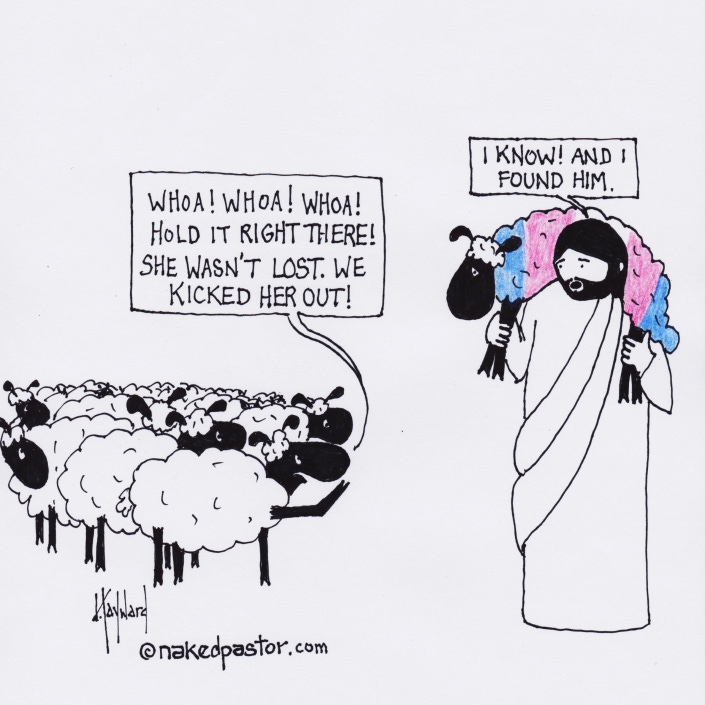
You have an amazing rector who happens to be transgender. And you have received the gift of his ministry precisely because you have been able to do this – to hear his story.
And in return he has heard you.
You have asked the questions and listened to each others' stories … and that is why this place is sanctuary for so many.
It is an honor to be here because I have seen from a distance how you are a community gathered outside the flock being and receiving Jesus in that sheep that is lost.
You all are beautiful.
I wish there were more communities like this one.
On the internet and around the world we don’t so much divide and conquer as we define and conquer. Label and dismiss. Strip away any nuance, which is the primary locus of beauty, and simplistically judge so that the other is not only more difficult to understand but easier to use for our own ends.
And it makes us all more afraid. It is breaking the world and killing us because it’s not just here and there.
As British Somali poet Warsan Shire writes,
“I held an atlas in my lap,
ran my fingers across the whole world
and whispered, where does it hurt?
It answered, everywhere, everywhere, everywhere.”
I stand up here in this pulpit with long sleeves over long sleeves.
And so have many of you.
And I wonder how many of us are saying to ourselves and each other, “I’m fine” … and when no one is looking, our faces drop and we cry … if we are lucky enough still be able to make tears.
So many times, the difference is a question
A question instead of a statement.
A question instead of a judgment
A question instead of silence.
So many times a question is the difference
Between judgment and compassion.
Enmity and community.
Death … and life.
So many times, the difference is a question:
What is your story?
Tell me why?
Amen.